Your filesystem, finally alive
Organon is a semantic layer over your filesystem. Every file becomes a living entity — with identity, context, relationships, and a lifecycle. Built for humans and AI agents alike.
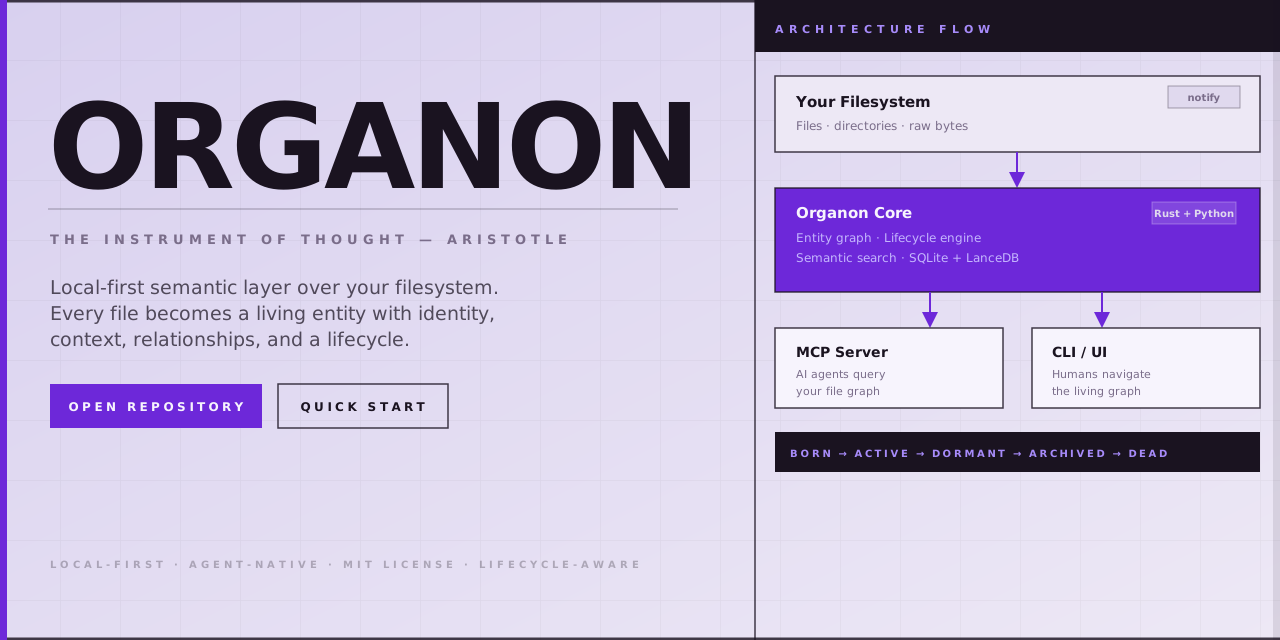
Organon is a semantic layer over your filesystem. Every file becomes a living entity — with identity, context, relationships, and a lifecycle. Built for humans and AI agents alike.
Files are not static blobs. They're created with intent, evolve over time, relate to other files, and eventually become irrelevant. No existing tool treats them this way.
Each file gets a stable identity, purpose description, tags, and a rich relationship graph — not just a path string.
Born → Active → Dormant → Archived → Dead. Organon tracks state transitions and surfaces what matters now.
Vector search via fastembed + LanceDB. Full-text via SQLite FTS5. Hybrid mode combines both with metadata filters.
Claude, Cursor, and any MCP-compatible agent can query, relate, and navigate your file graph directly.
Filesystem events drive entity creation and updates in real time. No manual indexing, no stale data.
SQLite for the entity graph. LanceDB for vectors. Everything lives on disk — no cloud dependency.
Every entity moves through a deterministic state machine. Transitions are triggered by filesystem events, git activity, access patterns, and explicit user commands.
A Rust core for speed and correctness, a Python AI layer for embeddings and extraction, and an MCP server that connects everything to any compatible AI agent.
Rust library. Filesystem watcher via notify. Entity graph in SQLite. Full-text search via SQLite FTS5. Lifecycle state machine.
Python. Content extraction for text, PDF, and code. Local semantic vectors via fastembed + LanceDB.
Rust-native MCP server exposing search, graph, context, and impact tools to agents. The organon CLI for power users: watch, find, graph, diff, export.
The organon binary covers watching, finding, searching,
graphing, diffing, and exporting. Global flags: --quiet,
-v, -vv.
# Watch a directory and index changes (runs the embedder too)
organon watch .

# Start the MCP server for Claude Desktop, Cursor, or any MCP agent
organon mcp                 # stdio mode
organon mcp --sse           # HTTP / SSE mode
organon mcp --scope ./src   # limit a session to a subtree

# Find entities with metadata filters
organon find --state active --ext rs
organon find --modified-after 2026-01-01 --larger-than-mb 10

# Semantic + full-text search with filters
organon search "watcher" --state active --ext rs --mode hybrid
organon search "embedding model" --mode vector
organon search --like src/auth.rs --limit 5

# Agent helpers — context packs, impact, change plans, tests
organon context "auth refactor" --scope . --budget 8000
organon impact src/auth.rs --depth 3
organon plan "add health command" --file src/main.rs
organon related-tests src/auth.rs

# Graph relationships — text, DOT, or Mermaid output
organon graph path/to/file.rs --depth 2 --format mermaid

# Inspect, diff, export, and check health
organon status path/to/file.rs
organon diff . --json
organon export --format json
organon health
organon doctor
Connect an agent with the step-by-step guides: Claude Desktop, Cursor, or the general agent usage reference.
Every dependency chosen for local-first, agent-native operation — nothing in the critical path requires a network call.
| Layer | Technology |
|---|---|
| Core library | Rust — notify · tokio · rusqlite (FTS5) |
| Semantic vectors | Python — fastembed · lancedb |
| Content extraction | Python — text · PDF · code |
| Agent protocol | MCP — Rust-native, Model Context Protocol |
| CLI | organon — watch · search · graph · context · plan |
| Storage | SQLite + LanceDB — 100% on-disk |
Install dependencies with uv sync (Python layer) and
cargo build --release (Rust core). See
setup.sh for full bootstrapping.